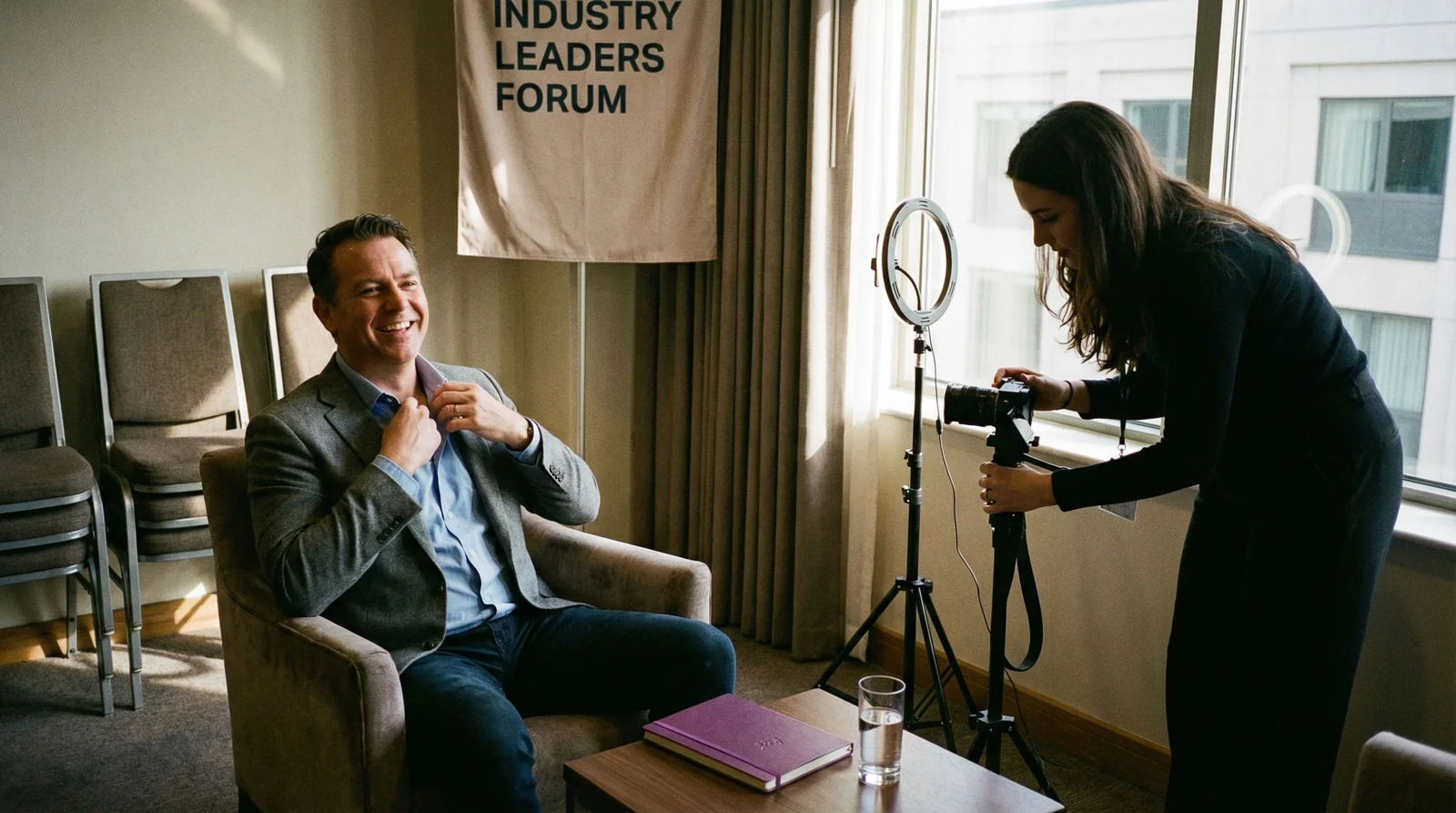
Why Unrehearsed Leadership Content Builds More Trust
Scripted leadership content signals effort. Unrehearsed leadership content signals truth. We break down why imperfection is what makes people believe what they are hearing from a founder or executive.

Hunter Lee Canning
Founder & CCO

Why Scripted Leadership Videos Underperform
Most leadership content is produced to look good. A polished video with tight editing, a blog post that reads like it went through six approval rounds, a LinkedIn caption that sounds like it was written by a committee. These things take real work to produce. And yet, they rarely move people.
The reason is simple: audiences are calibrated to detect performance. When a CEO reads from a teleprompter, the pacing is wrong. When a founder's LinkedIn post uses phrases they would never say out loud, the mask slips. Viewers and readers process this in seconds, often without being able to name what felt off. They just know something did.
Polished content signals effort. Unrehearsed content signals truth. Those two things aren't the same, and buyers know the difference.
What Happens When Leaders Speak in Real Conversations Instead of Scripts
Think about the last time you watched a founder interview on a podcast and thought, I want to work with that person. Chances are they said something unexpected. They paused before answering a hard question. They disagreed slightly with the interviewer. They used a specific example that was too strange to be invented.
That specificity is doing a lot of work. It tells the audience that the speaker has the experience they claim to have. It signals that the opinions came from somewhere real, not from a content calendar.
This is what happens inside a real conversation that a scripted video can't replicate. When a leader talks through a problem they're genuinely thinking about, the texture of that thinking comes through. The hesitation, the pivot, the small correction mid-sentence. All of it builds credibility in a way that no amount of production polish can manufacture.
Imperfection Isn't a Bug
We've worked with enough leadership teams to recognize the moment when someone watches their own raw footage and says, can we just clean that up a little? It is a reasonable instinct. Nobody wants to look uncertain in front of a camera.
But the things people want to smooth out are often the things their audience most needs to see. A long pause before answering signals that the person takes the question seriously. A correction mid-thought signals self-awareness. A blunt opinion signals that what comes next isn't carefully packaged marketing.
There is a particular kind of damage that happens when a founder over-edits their own voice. The content becomes technically competent and completely forgettable. It reads like it was produced by a company rather than said by a person. And the audience, without being able to articulate why, stops trusting it.
The goal isn't to publish unedited chaos. It is to preserve the parts that feel human. There is a version of editorial judgment that makes content sharper without making it sterile. A good editor removes the filler and keeps the friction. That friction, the place where the speaker is working through something in real time, is where the audience leans in. It is the mechanism by which trust forms.
Why Consistency Multiplies the Effect
A single unrehearsed moment can earn a click. Consistent unrehearsed presence earns a reputation.
When a leader publishes real thinking on a regular schedule, something compounds over time. The audience starts to expect it. They begin to follow not for entertainment but because the content reliably tells them something worth knowing. They bring a different quality of attention to it. That is the attention you want before a sales conversation.
Reputation is built by repeated exposure, not by a single impressive piece. A buyer who has read a founder's thinking across twenty posts over six months arrives at a sales conversation already oriented. They know how the founder sees the market. They've heard the founder push back on an idea they disagree with. They understand the company's position before the first slide is shown. That is what consistent unrehearsed content builds over time.
How to Start Publishing the Real Thing
The starting point isn't a camera and a script. It is a conversation. Talk through a problem your team is solving right now. Explain a framework you've been using in client work. React to something that happened in your industry last month.
Record it. Not to publish as a raw file, but to have source material. The ideas that come out of a genuine conversation are the ideas worth turning into a blog post, a clip, a post on LinkedIn. Those ideas will sound like you because they came from you, unfiltered.
At Plumwheel, that's the entire approach. We build content campaigns from real leadership conversations, then shape that material into the formats that reach the right audiences. One recorded conversation can produce a blog post, a short video clip, two or three LinkedIn posts, and an email that feels personal. The source is the same. The formats just serve different entry points.
If you want to see exactly how one conversation becomes a full month of content, read our piece on how one conversation becomes a month of content. It walks through the mechanics in detail. Or if you want to see how this works for your specific team, book a call at https://booking.plumwheel.com/ and we'll walk through what a content system built from your real conversations could look like.